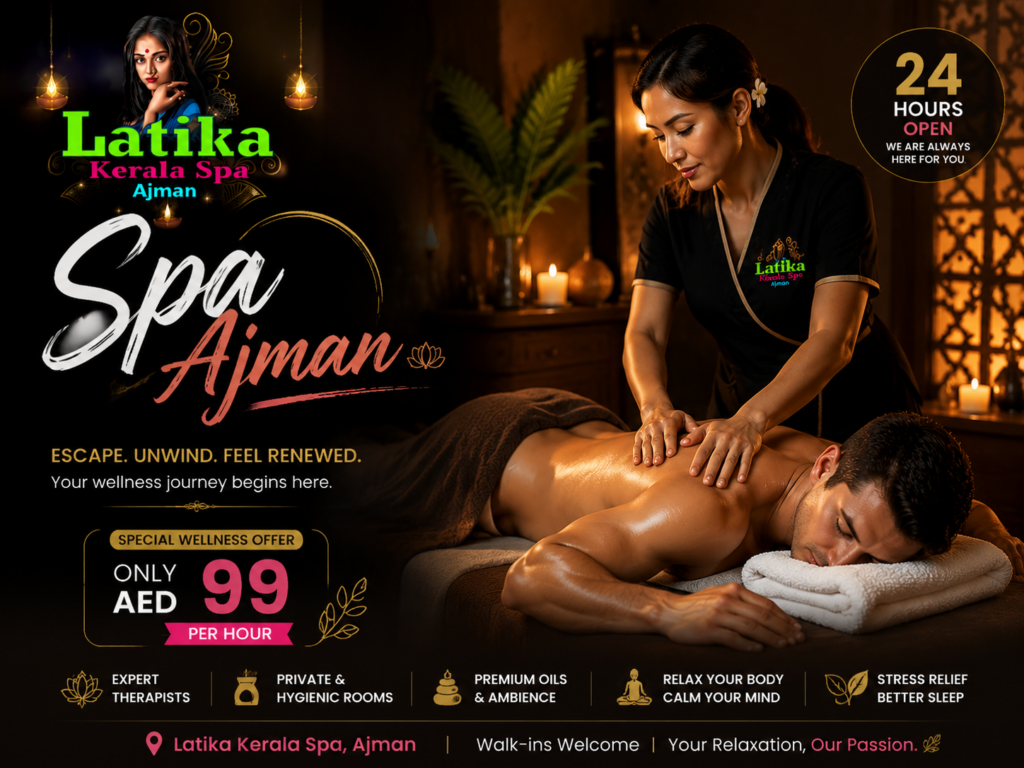
A physiotherapist friend in Ajman once said something that stuck with me: “People come in convinced their body is broken, when really it’s just been sitting in the same shape for too long.” That single line explains more about daily tension in this city than most wellness advice does — and it’s the same question we hear from almost every guest who walks into a spa in Ajman looking for relief. Park near the Corniche, walk for twenty minutes with the Gulf breeze on your face, head home feeling like the day has been shaken off — it’s a lovely ritual, and one nearly every resident swears by. It’s also, for most people, not doing what they think it’s doing.
The ache that builds up between 9 a.m. and 6 p.m. — from hunching over a laptop in Al Nuaimiya, gripping a steering wheel through Sheikh Khalifa bin Zayed Street traffic, or standing behind a counter in one of the malls near the Corniche — doesn’t live in the muscles that a walk stretches out. It lives deeper, in the connective tissue around the shoulder blades, the base of the skull, and the hip flexors. A walk improves circulation and mood. It rarely reaches the tissue that’s actually stuck.
This is the piece nobody tells you when they recommend “just go for a walk” or “stretch more.” Ajman’s lifestyle — humid heat that keeps people indoors and sedentary for long stretches, combined with long commutes and screen-heavy jobs — creates a very specific pattern of tension. Understanding that pattern is the first step to actually resolving it, and it’s a conversation we have often with guests at Latika Spa Ajman, where many clients arrive convinced their tension is “just stress” when it’s really mechanical.
Why the Corniche Breeze Isn’t Enough
There’s nothing wrong with an evening walk. The problem is expecting it to do a massage’s job.
The Circulation vs. Release Difference
Walking increases blood flow and can genuinely lift your mood — that’s real and worth keeping. But blood flow alone doesn’t release a muscle that has shortened and stiffened from six or eight hours in one position. Releasing that requires direct, sustained pressure applied by someone who knows the tissue layers, which is a mechanical intervention, not a cardiovascular one.
The Ajman-Specific Pattern
Because of the climate, a large share of daily movement in Ajman happens indoors and in air conditioning — offices, malls, cars. Compare that to a colder-climate city where people are forced to move more just to stay warm. The result is a population that’s often more sedentary than it looks, wrapped in a very active-looking social life of dinners, drives, and Corniche evenings.
The Real Sources of Tension in a Desk-and-Drive Life
Screen Neck
Hours of looking slightly down at a phone or laptop pull the head forward. For every inch the head shifts forward of the shoulders, the neck muscles work several times harder to hold it up. Over months, this becomes chronic tightness at the base of the skull and upper trapezius.
Steering Wheel Shoulders
Long commutes, especially in stop-start traffic, keep the shoulders elevated and rotated inward for extended periods. This is a different pattern from screen neck — it tends to sit deeper, closer to the shoulder blade itself.
Standing Fatigue
For those in retail, hospitality, or salon work around the Corniche and city centre, hours on tiled or marble floors load the lower back and calves in a way that a short walk doesn’t undo — it can even aggravate already-tired legs.
What Actually Resolves It (And What Doesn’t)
Stretching Helps, But Has a Ceiling
Stretching is genuinely useful for flexibility, but it works on the muscle you can consciously control. Deep, chronic tightness — the kind built over weeks of the same posture — often sits in tissue that stretching alone can’t reach effectively, because you can’t apply direct pressure to your own upper back or the base of your own skull.
Heat Helps Circulation, Not Structure
A hot shower or sauna session feels wonderful and does increase blood flow temporarily, but it doesn’t reposition or release tissue that has adapted to a fixed posture. It’s a complement to bodywork, not a replacement for it.
Targeted Massage Addresses the Actual Mechanism
This is where a therapist’s hands do something neither walking, stretching, nor heat can: apply sustained, directional pressure to the specific layer of tissue that’s shortened. At Latika Spa Ajman, therapists are trained to read where tension is actually sitting — not just where the client points — because the sore spot and the tight spot are often two different places.
Matching the Massage to the Problem
- Deep Tissue Massage — best suited for steering-wheel shoulders and chronic upper-back tightness, since it works through multiple muscle layers rather than just the surface.
- Thai Massage — a strong option for people whose tension comes with stiffness and reduced range of motion, since it combines stretching with pressure.
- Kerala Massage — traditionally uses warmed oils and rhythmic strokes, and is a good fit for those dealing with standing fatigue and general full-body heaviness.
- Hot Oil Massage — helpful when the priority is loosening surface muscle tightness while also calming the nervous system after a long, hot day.
- Indian Massage and Pakistani Massage — both draw on traditional techniques that focus on head, neck, and shoulder tension, which suits screen-neck patterns particularly well.
- Russian Massage — tends to use firmer, more structured strokes, and can suit those who want a more clinical, results-focused session.
A good therapist won’t just ask “relaxing or firm pressure” — they’ll ask about your job, your commute, and where you feel stiffness first thing in the morning, because that tells them far more than a generic pain scale.
Hygiene and Safety: What to Actually Check Before Booking
Anyone offering massage in Ajman should be able to answer a few basic questions without hesitation:
- Are linens changed and laundered after every single client, not just when visibly soiled?
- Are oils dispensed from sealed or pump containers rather than shared open jars?
- Is there a proper intake process asking about injuries, pregnancy, recent surgery, or skin conditions before the session starts?
- Are therapists trained to adjust pressure for people on blood thinners, with high blood pressure, or with varicose veins?
These aren’t box-ticking questions. A therapist who skips the intake conversation is more likely to apply generic pressure that could aggravate an existing issue rather than resolve it. At Latika Spa Ajman, every session begins with a short conversation precisely because posture history and existing conditions change how a therapist should work.
A Realistic Weekly Approach
Nobody needs a massage every single day, and expecting one session to permanently undo months of desk posture is unrealistic. A more sustainable pattern for someone with a genuinely sedentary, screen-and-commute lifestyle looks like this:
- Daily — two or three minutes of shoulder rolls and neck stretches at the desk.
- A few times a week — the Corniche walk, kept as the mood and circulation habit it’s good for.
- Every two to four weeks — a focused bodywork session, chosen based on where tension is actually sitting rather than habit.
This rhythm treats the walk and the massage as two different tools solving two different problems, rather than expecting one to substitute for the other.
Finding the Right Fit Near the Corniche
If you’re weighing options for a spa in Ajman Corniche, the details that matter more than décor are the ones covered above: a real intake conversation, visibly fresh linens, and a therapist willing to ask what your day actually looks like before deciding how to work on you. That combination is what separates a genuinely useful session from an hour that just feels nice in the moment.
For anyone who’s tried the walk, tried the stretching apps, and still ends the day with the same tight shoulders, it might simply be time to treat the tension as the mechanical problem it is. A session with someone trained to find where it’s actually stored — which is exactly the approach taken at Latika Spa Ajman — tends to reveal that the sore spot and the real problem were never quite in the same place.
Frequently Asked Questions
1. Why does my neck still hurt even after a daily Corniche walk? Walking improves circulation and mood but doesn’t apply the direct pressure needed to release muscles that have shortened from hours of forward head posture. The two address different problems.
2. Which massage type is best for someone who drives long distances daily in Ajman? Deep Tissue Massage is generally most effective for steering-wheel shoulder tension, since it works through the deeper muscle layers where that pattern tends to sit.
3. How often should I get a massage if I have a desk job? Every two to four weeks is a realistic, sustainable frequency for most people, paired with daily stretching and regular movement in between.
4. Is Hot Oil Massage suitable for Ajman’s humid climate? Yes, as long as the room is properly climate-controlled. Many people find warmed oil helpful for loosening surface tightness even in a hot, humid environment, since the treatment room itself is cooled.
5. What hygiene standards should I look for before booking a massage in Ajman? Fresh linens for every client, oils dispensed from sealed or pump containers, and a proper pre-session intake asking about injuries or health conditions are the key basics.
6. Can massage help with standing fatigue from retail or salon work?
Yes. Kerala Massage in particular, with its rhythmic full-body strokes, is often well suited to the leg and lower-back fatigue that comes from long hours on your feet.